- Cleaning the substrate
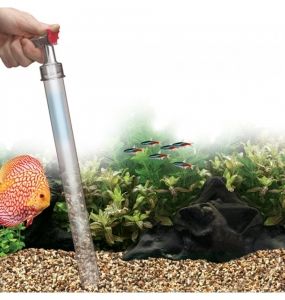
A gravel cleaner can be used to effortlessly remove food residues and even dead plant matter. The device also ventilates the substrate to prevent the generation of decomposition gases. Cleaning the substrate can ideally be combined with the partial water change.
- Cleaning the aquarium glass
The outside of the aquarium glass can be easily cleaned with a cloth and a little water. Please do not use cleaning agents! There are two ways of cleaning the inside of the glass: using either a magnet or a stainless steel blade with a handle. When using the blade, always be very careful not to damage the silicon seals as the blade is very sharp.
When using a magnetic glass cleaner, make sure that there is nothing between the magnet and the inside of the aquarium glass. Even the smallest grains of sand or stones can scratch the glass.
- Partial water changes
In the wild, the water cycle provides a constant supply of fresh water. In aquariums, you are responsible for removing old water polluted with the animals’ waste products and adding fresh water. Replace about 30% of the water with fresh water about every two weeks, depending on the size of the aquarium. The process is required more frequently for smaller aquariums and less frequently for larger ones. If you miss a water change and want to conduct it retrospectively, do not change too much water at once as your fish would find it very difficult to adapt to the change in water parameters.
- Plant care and fertilisation
All plants need light, carbon dioxide and nutrients for their growth. Particularly in the setup phase of an aquarium, algae can sometimes develop. Many aquarists do not use fertiliser for fear of causing algae, whereas, actually, correctly fertilised plants provide protection against algae!
The nutrients being present at the bottom of the aquarium consisting of fish waste and dead plant matter will not suffice as fertiliser for the aquatic plants. As drinking water does not contain all the minerals and trace elements that the plants need either, you need to fertilise them!
When setting up an aquarium, start with a slow-release substrate fertiliser. If you notice that the plants have stopped growing properly after about a year, re-fertilise them using tablet fertiliser.
Plants that absorb their nutrients from the water rather than the substrate (e.g. anubias species or waterweed) are fed with liquid fertiliser. We therefore differentiate between root fertilisation and leaf/stem fertilisation
Source: Tetra